Split country: understanding how West, East Ukraine actually differ
Sabtu, 01 Februari 2014
0
komentar
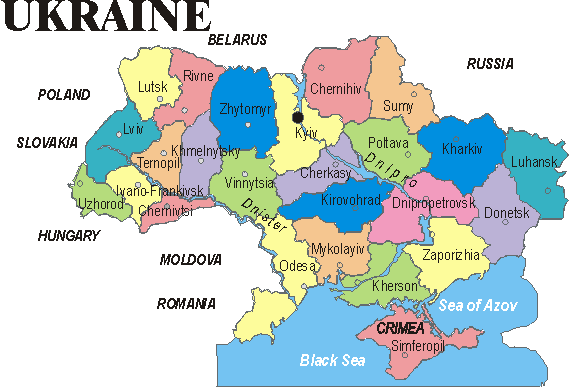
But the largely geographic tension between its two halves has been around for decades and it is apparently getting more serious and the "divorce scenario" starts to be discussed as a possibility which is why some "more divided, regional" perspective may be appropriate. Much of the information we are reminded of by the intelligent Czech media is arguably unknown to the typical people in the West who are being brainwashed by the idea that the "West Ukraine folks" must be the good ones (they're not told that they are the pro-Nazi, anti-Semites, homophobes etc.) while the East folks must be bad (they're not told that it's where the main industrial powerhouse is located, among other things).

Most of the polarization in the recent decade goes along this border between the official Ukrainian regions that could belong to the West Ukraine and to the East Ukraine; the particular map above shows the 2004 presidential elections. So I think (or propose) that the hypothetical division of the country would respect this boundary. However, I would argue that the historical border dividing Ukraine to two parts is very different, pretty much orthogonal to this one – and I mean that literally.
Fine. So what are the natural historical borders within Ukraine?

Well, the most natural intra-Ukrainian border is the Dnieper River (which goes from Kiev to the Black Sea), see the "cruise map" above. If you compare it with the previous map, you will see that the lines is almost exactly perpendicular to the previous one, so they don't really coincide. The Dnieper River divides the Ukraine into different two halves, the left-bank Ukraine and the right-bank Ukraine.
This division became very important in 1654 (I will ignore older history in this text): the left-bank Ukraine was merged with Russia. The right-bank Ukraine became a portion of the Russian Empire only in 1793 and 1795, i.e. 140 years later, when Poland was being divided. And this difference has implications.

This map has been relevant since 1654

The map as of 1793. See also 1795.
So it's largely true that the right-bank Ukraine roughly corresponds to the more pro-Russian regions of Ukraine but the border doesn't really coincide with the Dnieper River i.e. with the border relevant since 1654.
Except for the recent 2 decades, Ukraine was only independent of Russia once, in the early 20th century. Since the late 1920s, Ukraine was being devastated by the collectivization of agriculture, famine (Stalin killed 7 million Ukrainians in this way; some Russians were relocated there as a "replacement"), extermination of their elite, and other common left-wing policies that were being performed by the USSR in that case.
In the early stages of the war, much of Ukraine would be looking for help against this Stalinist terror in Germany. The Organization of Ukrainian Nationalists which had existed since 1929 and which is usually associated with Mr Stepan Bandera had a new strategy. They became allies of the Third Reich at the beginning of the war. When Hitler was celebrating some successful operations in the USSR, they would be viewed as friends but they were officially dismantled and incorporated to the Nazi power structure. However, they were de facto realizing the orders of Hitler on their territory. As soon as in 1943, they decided that Hitler is doomed and redefined themselves as warriors against all foreign forces including the Germans.
Various developments in the war would lead to the incorporation of several other historical regions, namely Czechoslovakia's Subcarpathian Rus', mostly Poland's Galicia, Romania's Northern Bukovina, and Romania's Southern Bessarabia (now mostly Moldova) into the Ukrainian Soviet Socialist Republic which is what Ukraine morphed into after the war again. In 1954, the last modification of the borders materialized when Nikita Khrushchev "donated" Crimea (the Peninsula) to Ukraine as a gift to the 300th anniversary of annexation of Ukraine by Russia (see above).
As I have said, the liquidation of the Ukrainian elites began in the late 1920s. It was only stopped during the era of destalinization in the early 1960s or so. However, in the 1970s and 1980s or so, there was a new era of brutal russification which ended sometime under Gorbachev. In 1991, Ukraine declared independence.
The Western regions mentioned above that used to belong to Romania and Czechoslovakia have strong links to Central Europe. On the other hand, the Eastern parts of Ukraine are more industrial and sort of wealthier but they have no emotional or other links to Central Europe. Sometime in three weeks, FC Viktoria Pilsen will play against Shakhtar Donetsk, also an Eastern industrial town (the team is much richer than ours, too). The industrial East plus Crimea is also the area that has backed Yanukovich, the current president. In fact, Crimea's officials recently urged Yanukovich to declare the martial law and if things go wrong for them (i.e. "orange"), they will probably try to declare autonomy i.e. independence of Ukraine.
The poorer, agricultural, and more nationalistically oriented West of Ukraine prefers to see its future within the EU. To some extent, this is just a historical repetition of their "forced alliance" with the Nazi Germany. Most of the "gastarbeiters" in the EU come from the Western Ukraine; the Eastern folks don't want to emigrate much.
The Eastern part of the Ukraine is the one where the Russian-speaking population is at least substantial; the West is predominantly culturally Ukrainian. 17% of the citizens of Ukraine consider themselves ethnic Russian but 30% of the citizens consider Russian to be their mother tongue (quite a difference).
The nation prefers the Orthodox Church which is internally split in some complicated ways, too; about 5 millions of citizens (over 10%) almost entirely located in the Western regions believes in the Greek Catholic Church's values.
This modern separation of Ukraine became obvious in the 2004 elections. The pro-Western side would win but it was soon crippled by internal disagreements (Yushchenko vs Tymoshenko) which allowed Yanukovich to legitimately return to power a few years ago.
Split: who wants it
Voice of Russia argues that Hungary and Romania began to promote the split of Ukraine. It may be just some fog, however, because it is generally expected that Russia would be the greatest winner if the country were split because the East would become de facto if not de iure a part of Russia.
If you said that this should mean that the Eastern Ukrainian politicians therefore want the country to be split, you would be wrong. They don't really want it because they would lose influence to the "real" Russians. ;-)
Well, there are persistent polarizing problems in Ukraine and a divorce is a possible solution (or next step). If it were done, it would be good if people tried to do it in the "velvet way". The folks should surely hire Václav Klaus who was the true mastermind behind the velvet character of the Czechoslovak Velvet Divorce (that was otherwise imposed on him and us by some historical facts and inevitable mood swings in much of Slovakia). The new countries should negotiate the best possible conditions. Maybe, a temporary stage of a "loosened coexistence" that would resemble Czechoslovakia before 1993 could be helpful.
At any rate, people should have an idea what the split would actually mean and how the parts would differ when it comes to their opinions, emotions, values, economic strength, and dominant portions of the economy. I feel that many people in the West are being deliberately misled about all these points.
And that's the memo.


TERIMA KASIH ATAS KUNJUNGAN SAUDARA
Judul: Split country: understanding how West, East Ukraine actually differ
Ditulis oleh Unknown
Rating Blog 5 dari 5
Semoga artikel ini bermanfaat bagi saudara. Jika ingin mengutip, baik itu sebagian atau keseluruhan dari isi artikel ini harap menyertakan link dofollow ke https://androidemoticonss.blogspot.com/2014/02/split-country-understanding-how-west.html. Terima kasih sudah singgah membaca artikel ini.Ditulis oleh Unknown
Rating Blog 5 dari 5



0 komentar:
Posting Komentar